Why 'make it sound human' never quite lands, choom
AI writing gives itself away on three levels: the characters, the words, and the shape of the whole piece. The deepest one is welded in while the text is being written, which is why a clean-up pass at the end cannot fully fix it.
You have probably run it. You pull a paragraph out of ChatGPT, it reads a bit stiff, so you ask it to “make this sound human” or paste it into one of those humanizer rigs. The result is better. It is also still a little off. Something about it keeps tagging the game.
There is a reason, choom, and it is worth clocking before you trust any rig that promises to fix it. AI writing gives itself away on three separate levels, and they are not equally easy to strip.
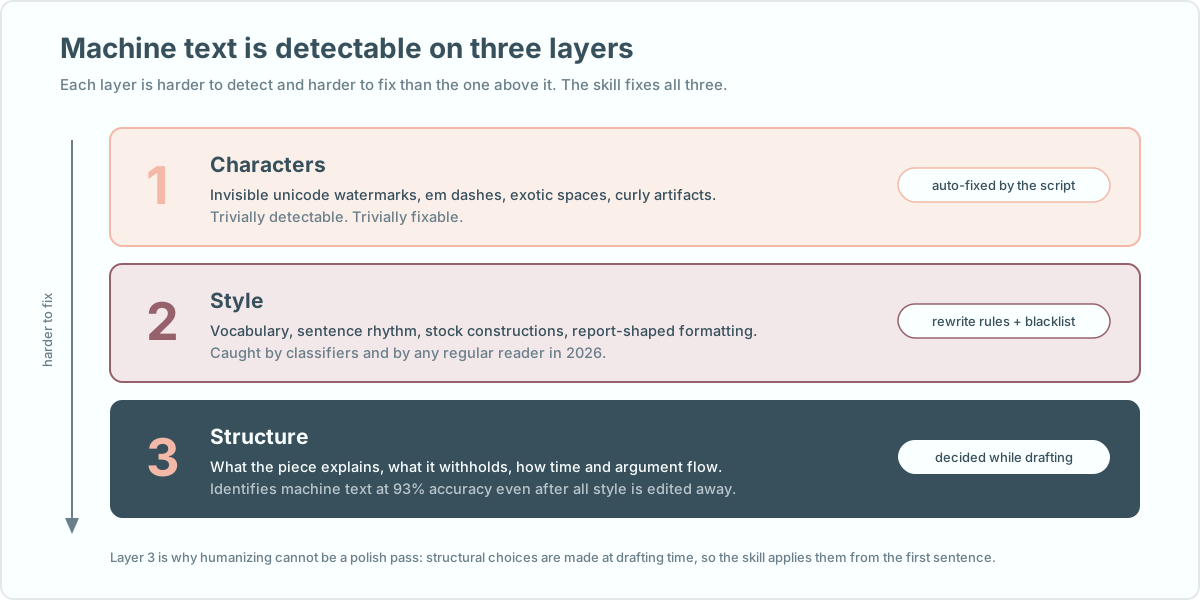
The top layer: the stuff you cannot see
Start with the easy score. Model output is littered with characters a normal keyboard does not produce. The long dash. Invisible spaces sitting between words doing nothing except tagging the text as machine-made. A special kind of blank space some models slip in like a signature daemon.
You will never clock these by reading. But a detector will, and so will anyone who pastes your text into a checker. The good news is this layer is trivial to clean. A small script finds every one of these characters and deletes them. Done.
If humanizing were only this, the button-press rigs would work perfect. They do not.
The middle layer: the words and the beat
This is the one you can feel but struggle to name. It is the vocabulary, “delve”, “leverage”, “seamless”, “robust”, words jacking into AI text constantly and into a real person’s email almost never. It is the love of lists that come in threes. And most of all, it is the rhythm.
Read three AI paragraphs in a row and count the words per sentence. They hover around twenty, every time, one after another, like bricks in a wall. A choom does not write like that. A choom writes a long winding sentence and then a short one. Then a fragment. The unevenness is the human part.
A find-and-replace rig can swap “delve” for “look at”. It cannot hand your writing a natural beat, because that is not a word problem. It is a whole-sentence problem, and fixing it means rebuilding sentences, not swapping words. Do it sloppy and you get a fresh tell: correct grammar with slightly wrong word choices, the mark of text run through a synonym machine.
The bottom layer: the shape of the thing
Here is the one almost nobody talks about, and the reason the “fix it at the end” play is doomed.
The deepest tell is not any word or character. It is how the piece is built. AI writing explains its own point at the end, like it does not trust you to get it. It ties every thread up too neat. It stays careful and neutral instead of holding an opinion. It gestures at “a well-known study” instead of naming one. Researchers found this structural fingerprint alone flags machine text about nine times out of ten, even after every word and character has been scrubbed.
And you cannot bolt structure on after the fact. By the time the paragraph exists, its shape is welded. Whether it hedges, whether it names real things, whether it leaves a thread dangling the way real writing does: those get decided as the sentence is born, not touched up later.
So what actually fixes it
The only real fix is to write different from the first word, all three layers in mind at once. That is the whole idea behind Ghostwriter, the free rig I built. It does not sit at the end and polish. It changes how the text is written in the first place, then runs the character clean-up as a last check instead of the main event.
A humanizer works the layer you can see. The tells that actually flag you ride on the two layers you cannot, choom.