How to spot AI writing before you hit send
A quick, non-technical checklist for catching the giveaway signs of AI-written text in your own drafts: the vocabulary, the lists of three, the flat rhythm, the long dash, and the too-neat ending.
Once you know what to look for, you cannot stop seeing it. The LinkedIn post that opens with “In today’s fast-paced world”. The product email that “delves into” its own features. The cover letter where every sentence is the same tidy length. It reads fine on the surface, and it quietly screams “a machine wrote this”.
You do not need a detector to catch it. Here is what to scan your own drafts for before you send anything you wrote with AI help.
The words that give it away
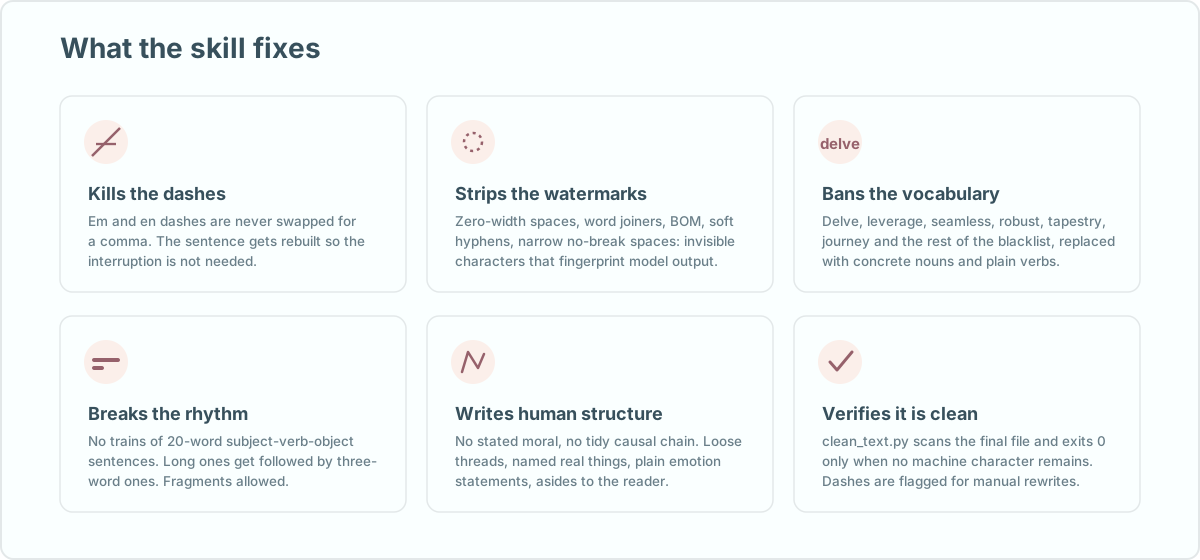
Some words barely exist in normal speech but turn up constantly in AI text. Delve. Leverage. Seamless. Robust. Foster. Elevate. Unlock. Tapestry. If your draft reaches for any of these, a real person almost certainly would not have.
The fix is not a fancier synonym. It is a plainer, more specific one. “Leverage your network” becomes “ask people you know”. “A seamless experience” becomes “it just works”. Concrete beats impressive every time.
The love of threes
AI has a thing for groups of three. Three bullet points. Three punchy fragments in a row. “Fast, simple, and powerful.” Watch for it, because once per piece is natural and three-in-every-paragraph is a fingerprint.
When you catch one, break it. Use two items, or four, or just one. “It’s fast and honestly a bit fiddly to set up” beats a clean triple, partly because it admits something real.
The flat rhythm
This is the biggest one, and the easiest to feel once you know it. Read your draft out loud. If every sentence takes about the same breath, one after another after another, that is the tell. Human writing lurches. A long thought, then a short one. Then a fragment. Like that.
The fix is to vary it on purpose. Chop one long sentence in half. Let a three-word sentence stand alone. The unevenness is what sounds like a person.
The long dash and the invisible junk
The long dash, the one wider than a hyphen, is a dead giveaway because almost nobody types it by hand. There are also characters you cannot even see: invisible spaces and marks that ride along in copied AI text and light up every detector. You will not catch those by reading, which is the one place a tool genuinely earns its keep.
The too-neat ending
Last one, and the sneakiest. AI loves to end by explaining what it just told you. “Ultimately, this shows that…” “In conclusion…” Real writing usually just stops, on a point or a consequence, and trusts you to have followed along.
If your last paragraph is a summary of the paragraphs above it, delete it. The piece almost always ends better one line up.
Run those five checks and you will catch most of it yourself. For the invisible-character layer, and for rewriting the rhythm without it turning into synonym soup, that is what Ghostwriter handles, and why a quick “make it human” pass misses the deeper tells. This is also the same instinct behind spotting AI slop in anything you read, not just your own drafts.